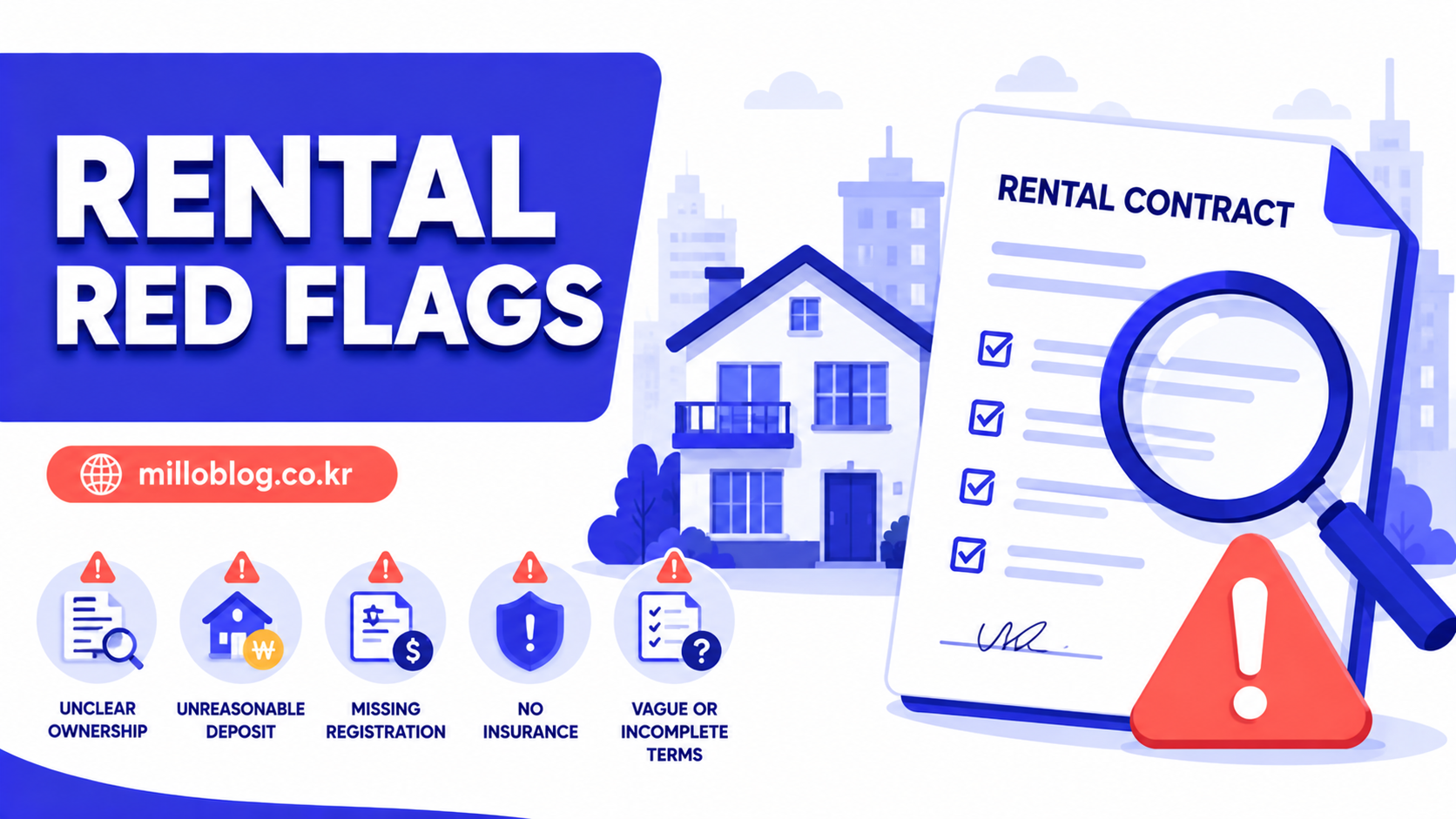
Red flags in Korean rental contracts often hide in plain sight — inside the property registry, not the lease itself. In this guide, you’ll learn the five warning signs that precede almost every jeonse fraud case, and exactly how to check each one before you transfer a single won.
Table of Contents
- Why Do Red Flags in Korean Rental Contracts Matter So Much?
- Is the Landlord Actually Who They Claim to Be?
- Does the Property Registry Show Hidden Debt?
- Is the Deposit Suspiciously High for the Property?
- Is the Contract Using Non-Standard Paperwork?
- Where Is Your Deposit Actually Being Transferred?
- Frequently Asked Questions
- Final Thoughts
Why Do Red Flags in Korean Rental Contracts Matter So Much?
Korea’s jeonse system asks tenants to hand over deposits worth 50–80% of a property’s value, so a single missed warning sign can wipe out years of savings.
The Scale of the Problem
By mid-2025, the Ministry of Land, Infrastructure and Transport had officially recognized over 32,000 people as victims under the Special Act on Supporting Jeonse Fraud Victims, with young adults in their 20s and 30s making up 75% of cases.
Why Foreigners Are Targeted More Often
A common mistake foreigners make is trusting a realtor’s verbal reassurance instead of pulling the property registry themselves. Fraud rings have specifically targeted tenants unfamiliar with Korea’s registration system.
⚠️ Important: No red flag below is optional to check. Skipping even one has been the deciding factor in real fraud cases. Always confirm current risk indicators at the Ministry of Land, Infrastructure and Transport before signing.
Is the Landlord Actually Who They Claim to Be?
The single most common jeonse fraud starts here: the person signing your contract doesn’t legally own the property.
Red Flag: Name Mismatch
If the name on the contract doesn’t match the registered owner shown on the property registry, stop immediately. Some fraud rings hold properties under a spouse’s or relative’s name to spread liability across multiple units.
Red Flag: No Power of Attorney
If someone signs “on behalf of” the owner, request a notarized power of attorney and a certified seal certificate before proceeding.
Verification Step
- Step 1: Ask for the landlord’s photo ID at the viewing.
- Step 2: Compare the ID name against the registry owner’s name.
- Step 3: For local tax concerns, apply to check the landlord’s unpaid local taxes at the district tax office, with the landlord’s consent.
💡 Pro Tip: When many expats first arrive in Korea, they assume a friendly, English-speaking landlord is automatically a safe one. Friendliness has nothing to do with legal ownership — always verify the paperwork.
Does the Property Registry Show Hidden Debt?
This single document — the deunggibu deungbon (등기부등본) — reveals almost every red flag a fraudulent contract tries to hide.
Step 1: Pull a Fresh Copy Yourself
Don’t accept a copy from the landlord or agent; it may be outdated. Pull your own at the Supreme Court’s Internet Registry Office, which costs roughly ₩700–1,000 and takes about five minutes.
Step 2: Check for Mortgages and Liens
Add up all priority debt listed on the registry, then add your deposit amount. If the combined total exceeds 70% of the property’s current market value, you are in a high-risk position.
Step 3: Include Cancelled History
Select the option that includes cancelled entries (말소사항 포함) so you can see the property’s full history of past liens, not just current ones.
| Registry Finding | Risk Level | What It Means |
|---|---|---|
| Owner name matches ID | Low | Standard verification passed |
| Deposit + debt under 70% of value | Low–Medium | Generally considered safer |
| Deposit + debt over 70% of value | High | Deposit may not be recoverable in auction |
| Multiple liens or recent ownership changes | High | Possible concealed debt or fraud pattern |
⚠️ Important: If the registry shows figures you don’t understand, get a professional review before signing. Always confirm current thresholds at the official Internet Registry Office.
Check the Property Registry (IROS)Is the Deposit Suspiciously High for the Property?
An inflated deposit is one of the clearest red flags in Korean rental contracts, especially for villas and officetels.
Red Flag: Deposit Near 80–90% of Sale Value
Compare the asking deposit against recent sale transactions for similar units — same size, floor, and orientation. If the jeonse deposit sits at 80–90% of the sale price, treat it as high-risk.
Red Flag: New or Unusual Villas and Officetels
Multi-family housing and officetels account for over half of reported rental fraud cases, largely due to opaque pricing and lower market oversight compared to standard apartments.
How to Check Comparable Prices
- Step 1: Search recent sale (매매) history for the same building or nearby units.
- Step 2: Compare your proposed deposit against that sale value.
- Step 3: Walk away if the property’s value has recently dropped and the deposit stayed the same.
Is the Contract Using Non-Standard Paperwork?
A rushed or informal contract is often the easiest red flag to catch — if you know what the real one looks like.
Use the Government’s Standard Lease Form
A proper Korean lease should use the government’s standard rental contract (표준임대차계약서). If your agent doesn’t offer it, ask directly — it’s the form both landlords and tenants are already familiar with.
Confirm Every Required Field Is Filled In
The contract must clearly state the full address with floor and unit number, both parties’ ID numbers, the deposit in figures and Korean text, lease dates, and the maintenance fee amount.
Put Verbal Promises in Writing
Any special conditions agreed to verbally — included appliances, planned repairs, repainting — must be written into the contract itself, not left as a spoken agreement.
💡 Pro Tip: Photograph the unit’s condition before move-in and attach the photos to the signed contract. This protects your deposit from unfair damage claims at checkout.
Where Is Your Deposit Actually Being Transferred?
How the money moves is just as important as who you’re paying it to.
Red Flag: Cash, Agent Account, or Third-Party Account
Korean rental deposits should be paid by direct bank transfer to the registered property owner’s account — never in cash, and never to an agent’s personal account.
Red Flag: Pressure for an Urgent Payment
Scammers typically avoid traceable payments and push for urgency. A legitimate landlord will always be willing to arrange an in-person meeting and answer questions calmly.
Protect the Deposit After Payment
- Step 1: File your move-in registration (전입신고) at the district office on move-in day, without delay.
- Step 2: Get the fixed-date stamp (확정일자) on the same visit to secure legal payment priority.
- Step 3: If your deposit exceeds relevant thresholds, confirm the lease was properly reported under the Jeonse and Monthly Rent Reporting System (전월세신고제).
⚠️ Important: Even a one-day delay in move-in registration can let a landlord take out new loans that legally rank above your deposit. Always confirm the current reporting thresholds at the Ministry of Land, Infrastructure and Transport.
For extra protection, especially on large jeonse deposits, check whether you’re eligible for a state-backed guarantee.
Check HUG Deposit Guarantee InsuranceFrequently Asked Questions
What is the single most important red flag to check first?
Whether the person signing the contract is the actual registered owner shown on the property registry. Most jeonse fraud starts with a name mismatch or unauthorized signer.
Can foreigners access the Korean property registry themselves?
Yes. The registry is available at the Internet Registry Office for a small fee, though it’s only in Korean, so professional review is strongly recommended if you’re unsure how to read it.
What deposit-to-value ratio is considered dangerous?
Once your deposit plus the landlord’s existing debt exceeds roughly 70% of the property’s market value, you’re in a high-risk position if the landlord defaults or the property goes to auction.
Is it safe to let my agent handle move-in registration for me?
Move-in registration should be completed in person by the tenant. If your agent offers to handle it, verify independently that it was actually filed.
Are officetels and villas riskier than regular apartments?
They can be. Multi-family housing and officetels account for a large share of reported rental fraud cases, partly due to less market oversight than standard apartments.
What should I do if I already suspect fraud?
Report the incident to your local police cyber crime division with your lease agreement, payment records, and communication history, and contact your local Foreign Resident Center for guidance.
Does deposit guarantee insurance cover every type of fraud?
Coverage depends on eligibility, property type, and existing liens, and terms change over time, so confirm current policy details directly with HUG before relying on it.
Final Thoughts
Most Korean rental fraud follows the same pattern: a mismatched owner name, hidden debt on the registry, or a deposit priced above the property’s real value. Check all three before you transfer anything, use the government’s standard contract, and register your move-in the same day you sign. These few checks take an afternoon — losing a deposit takes years to recover from.
Official Sources
- Supreme Court Internet Registry Office (IROS)
- Ministry of Land, Infrastructure and Transport
- Korea Housing & Urban Guarantee Corporation (HUG)
- Easy-to-Find Legal Information (찾기쉬운 생활법령정보)