
This guide is based on firsthand experience and official Korean government and T-money sources. Last updated: July 2026.
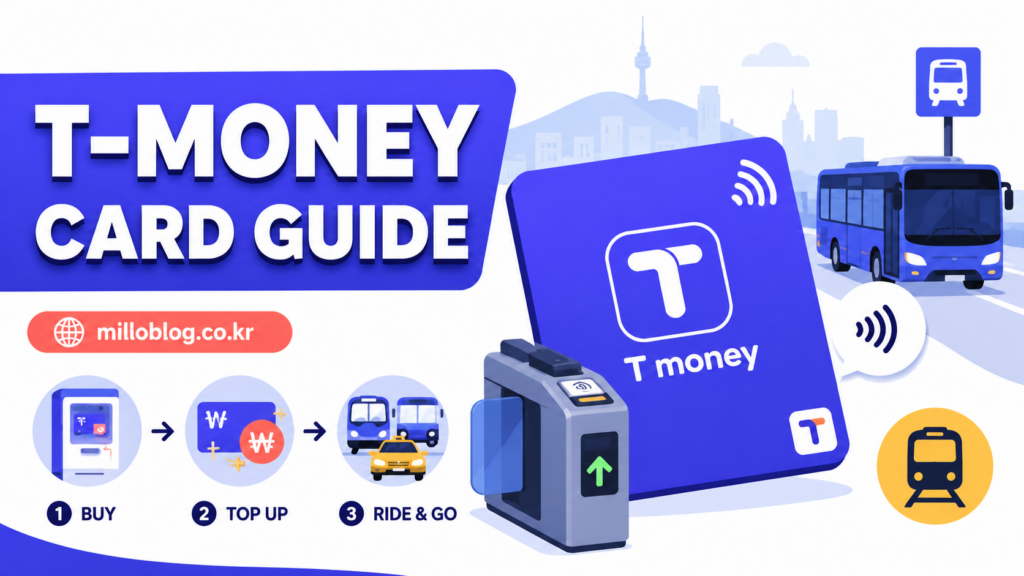
A T-money card is the small rechargeable card that lets you tap onto every subway, bus, and most taxis in Korea without buying a ticket each time. In this guide, you’ll learn where to buy a T-money card, how to top it up, how much rides cost, and how to get a refund before you fly home.
Table of Contents
- What Is a T-Money Card and Why Do You Need One?
- Where Can You Buy a T-Money Card in Korea?
- How Do You Top Up a T-Money Card?
- How Do You Use a T-Money Card on Buses, Subways, and Taxis?
- How Much Does It Cost to Ride With a T-Money Card?
- How Do You Get a Refund on a T-Money Card?
- Which T-Money Alternative Should You Choose?
What Is a T-Money Card and Why Do You Need One?
A T-money card is a prepaid, rechargeable smart card that covers subways, city buses, airport buses, and many taxis across South Korea. You load cash onto it, then tap it on a reader every time you ride. It removes the need to work out exact change or buy a paper ticket at a machine you can’t read.
What Can You Pay for With It?
Beyond transport, you can use the same card at convenience stores such as GS25, CU, and 7-Eleven, at some cafes and fast-food chains, and at coin lockers inside subway stations. Anywhere you see the T-money logo at the register, you can tap to pay.
Does It Ever Expire?
The physical card itself does not expire and you can reuse it on future trips. Any stored balance stays valid for 5 years from your last top-up or ride, so a leftover balance from an old trip is usually still spendable.
💡 Pro Tip: Buy your card and load a small amount the moment you land — it saves you the hassle of digging for exact bus fare on day one.
Where Can You Buy a T-Money Card in Korea?
You have three realistic options as a foreigner: a convenience store, a subway station kiosk, or an airport counter. All three work the moment you land.
Step 1: Buy at a Convenience Store
- Step 1: Walk into any GS25, CU, 7-Eleven, Ministop, or emart24.
- Step 2: Ask the cashier for a “T-money card” (or say “T-money” and point to the register display).
- Step 3: Pay the card fee in cash, usually ₩2,500 to ₩4,000 depending on the design.
Step 2: Consider the Foreigner-Focused Version
The T-money Travel Card, priced around ₩4,000, is aimed specifically at visitors and bundles in discounts at partner shops, attractions, and tour operators. It replaced the older Korea Tour Card, which is no longer issued. If you want extra currency features on top, the WOWPASS card doubles as a T-money card and a fee-free debit card for around ₩5,000.
Step 3: Buy at the Airport or Subway Station
Incheon and Gimpo airports both sell T-money cards at arrival-hall convenience stores and ticket counters. Inside any subway station, look for a ticket vending machine or the staffed information counter.
⚠️ Important: Card prices and available designs change by location and season. Always confirm the latest details at T-money’s official English site before you travel.
WOWPASS vs T-money: Which Card Should You Get?
How Do You Top Up a T-Money Card?
Topping up, or “charging,” a T-money card takes seconds once you know where to go. When many expats first arrive in Korea, they assume a foreign credit card will work everywhere — it usually won’t, so plan on cash for most reloads.
Step 1: Reload at a Convenience Store
- Step 1: Hand your card and cash to the cashier.
- Step 2: Tell them the amount you want to add, in units of ₩1,000.
- Step 3: Tap your card on the pad to confirm the new balance.
Step 2: Reload at a Subway Station Kiosk
- Step 1: Select English on the touchscreen.
- Step 2: Place your card on the reader pad.
- Step 3: Choose an amount and insert Korean won bills — most machines only take cash.
How Much Should You Load First?
A first top-up of ₩10,000 to ₩20,000 covers several subway and bus rides while you settle in. The minimum load is ₩1,000, and stored balance is capped at ₩500,000.
💡 Pro Tip: Some newer kiosks at major Seoul stations now accept foreign Visa, Mastercard, and UnionPay cards for top-ups, but this rollout is not yet nationwide. Confirm the latest details at T-money’s official English site before relying on a card instead of cash.
How Do You Use a T-Money Card on Buses, Subways, and Taxis?
Using the card is the same simple motion everywhere: tap on, tap off. A common mistake foreigners make is tapping only once on a bus, which leads to being charged the maximum possible fare.
On the Subway
- Step 1: Tap your card on the yellow reader at the entry gate.
- Step 2: Ride to your stop.
- Step 3: Tap again at the exit gate so the correct fare is calculated.
On City and Airport Buses
Tap when boarding at the front door and tap again when leaving through the back door. Skipping the exit tap means the system assumes the longest possible ride and charges you accordingly.
In Taxis
Look for a T-money sticker on the door or dashboard. Hand your card to the driver or tap it on the in-car terminal at the end of the ride, just as you would with a regular payment card.
💡 Pro Tip: Riding as two people on one card is possible on buses — tell the driver “two people” before you tap so the fare adjusts. On the subway, every rider needs their own card to pass the gate.
How Much Does It Cost to Ride With a T-Money Card?
Fares are distance-based on the subway and flat-rate on most city buses, and a T-money card always costs a little less than paying cash.
| Fare Type | Approximate T-Money Fare |
|---|---|
| Seoul subway, base fare (up to 10km) | ₩1,550 |
| Seoul subway, each additional 5km | +₩100 |
| Seoul city bus, base fare | Roughly ₩1,500, cheaper than cash |
| Transfer between bus and subway | Up to ₩100+ discount, within the transfer window |
How the Transfer Discount Works
Paying with a T-money card unlocks a transfer discount when you switch between subway and bus, or between two buses, within 30 minutes of your last tap (extended to 1 hour overnight, from 9pm to 7am). You can use this discount up to four times a day.
⚠️ Important: Fares are adjusted periodically by local transport authorities. Confirm the latest details at Visit Korea’s official transportation page before budgeting your trip.
Seoul Subway Map and Line Guide for First-Timers
How Do You Get a Refund on a T-Money Card?
You can cash out your remaining balance before you leave Korea, though the original card purchase price is never refunded.
Step 1: Find a Refund Counter
Head to a T-money Town location, a subway station customer service counter, or a participating convenience store for smaller balances.
Step 2: Request Your Balance
- Step 1: Hand over your card and tell staff you want a refund.
- Step 2: A service fee of ₩500 is deducted from your balance.
- Step 3: Receive the remainder in cash, in Korean won.
Partial Refunds
Partial refunds are only available at T-money Town or a subway station service center, and only for amounts between ₩10,000 and ₩50,000, refunded in ₩10,000 units.
💡 Pro Tip: If you plan to visit Korea again within 5 years, it’s often easier to just keep the card and its balance rather than refund a small amount.
Which T-Money Alternative Should You Choose?
T-money isn’t the only option, and depending on your trip length or spending habits, an alternative card might suit you better.
| Card | Best For |
|---|---|
| T-money (standard) | Most visitors; widest acceptance nationwide |
| WOWPASS | Travelers who want a currency exchange card plus transit in one |
| Climate Card | Longer stays in Seoul with frequent daily rides |
| Cashbee | Backup card with near-identical coverage to T-money |
Ready to get set up before you land? Check current card options and top-up rules directly on the official site.Visit T-money’s Official English Site
Seoul Climate Card vs T-Money: Which Saves You More?
Frequently Asked Questions
Can I use a T-money card for two people at once?
On buses, yes — tell the driver how many people are riding before you tap. On the subway, each rider must tap their own card to pass through the gate.
Does my T-money card work outside Seoul?
Yes, it works in most major Korean cities including Busan, Daegu, Daejeon, and Gwangju, though a few local buses and machines may still be cash-only.
Can I load my T-money card with a foreign credit card?
Generally no at convenience stores, which require cash. A growing number of newer subway kiosks accept foreign cards, but coverage is still limited, so confirm before relying on this.
What happens if my balance runs out mid-ride?
Most subway gates allow a small negative balance so you can still exit. Top up as soon as possible afterward to avoid being blocked on your next ride.
Is the T-money Travel Card different from a regular T-money card?
Functionally they work the same for transport. The Travel Card simply adds bonus discounts at tourist-facing shops and attractions for a slightly higher purchase price.
Can I get my money back before I fly home?
Yes, at a T-money Town, subway service counter, or participating convenience store, minus a ₩500 service fee.
Do I need a T-money card if I’m only staying a few days?
It’s still worth it. Buying single tickets for every ride costs more overall and takes longer at each machine.
Final Thoughts
A T-money card is one of the smallest purchases that makes the biggest difference to a trip in Korea. It saves you money on every ride through transfer discounts, works across subways, buses, taxis, and convenience stores, and takes under a minute to buy or reload. Grab one at your first convenience store stop, load a modest amount to start, and top up as you go.