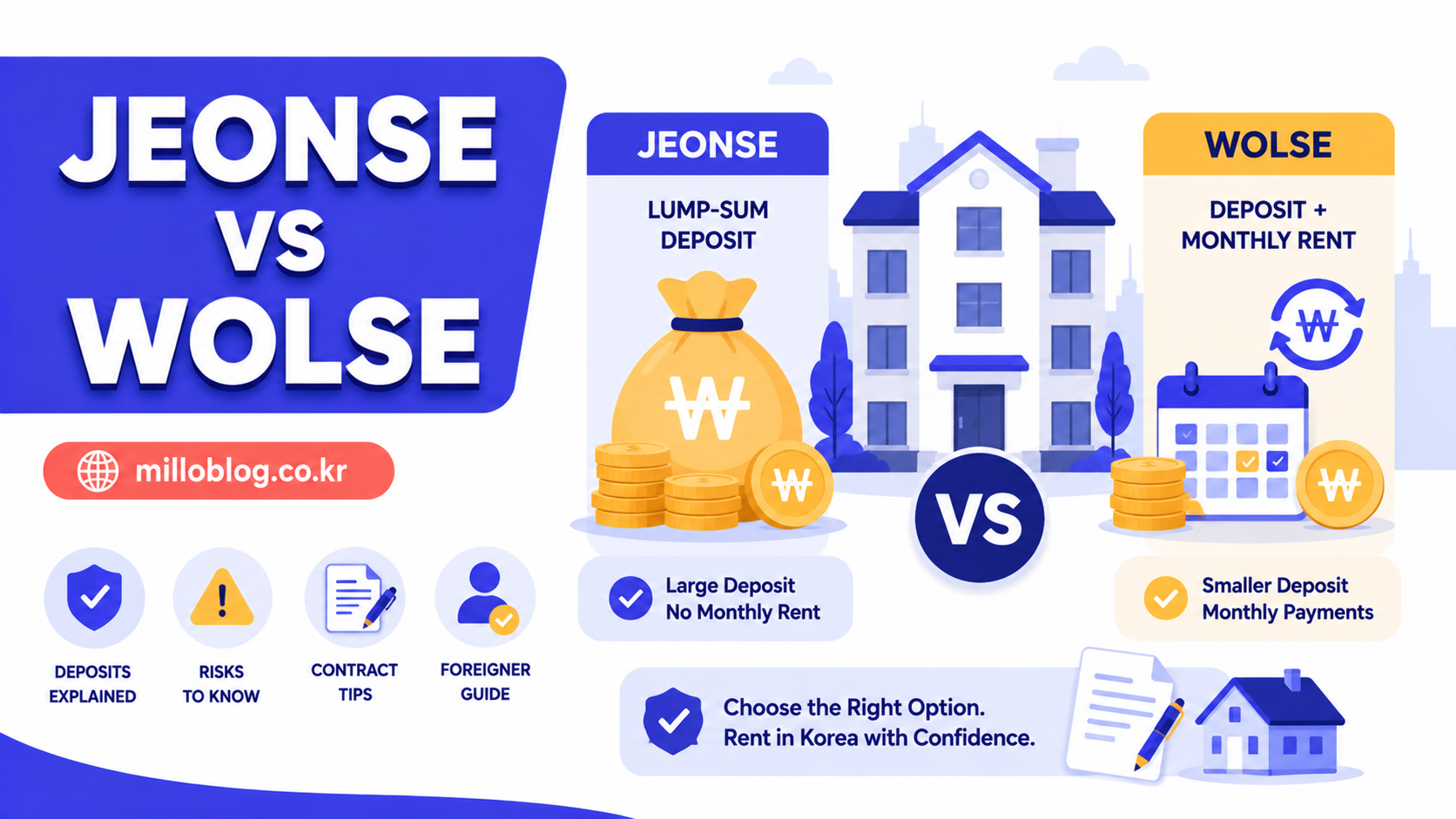

Jeonse means a huge refundable deposit and zero monthly rent. Wolse means a smaller deposit plus a monthly payment, closer to renting back home. In this guide, you’ll learn exactly how jeonse vs wolse works for foreigners in Korea, how much cash each option really needs, and how to protect your deposit from scams.
Table of Contents
- What Is the Difference Between Jeonse and Wolse in Korea?
- Which One Should You Choose as a Foreigner?
- How Much Deposit Do You Actually Need?
- How Do You Protect Your Deposit From Jeonse Scams?
- Can Foreigners Get a Jeonse Loan in Korea?
- What Documents Do You Need to Sign a Lease?
- Frequently Asked Questions
- Final Thoughts
What Is the Difference Between Jeonse and Wolse in Korea?
Korea’s rental market runs on a system most foreigners have never seen before. Instead of a simple monthly rent, you’ll usually be offered one of two structures — or a hybrid of both.
Jeonse (전세): The Lump-Sum Deposit System
With jeonse, you hand your landlord one large deposit — often 50-80% of the home’s market value — and pay no monthly rent for the full lease term. The landlord invests or uses that cash, and returns it to you in full when you move out.
Wolse (월세): Deposit Plus Monthly Rent
Wolse is the closer cousin of Western-style renting. You pay a smaller deposit (called bojeunggeum, 보증금) plus a fixed monthly rent. Listings are usually written as two numbers separated by a slash, like “1000/50” — the deposit first, then the monthly rent, both in units of 10,000 KRW.
Banjeonse (반전세): The Middle Ground
Banjeonse blends both systems — a bigger deposit than wolse, but smaller than full jeonse, combined with a reduced monthly rent. It’s become increasingly common since interest rates rose, because it lowers how much cash a tenant has locked up in one lump sum.
| System | Deposit Size | Monthly Rent | Best For |
|---|---|---|---|
| Jeonse | Very large (50-80% of home value) | None | Long stays, large savings |
| Wolse | Small (often 1-3 months’ rent) | Fixed monthly payment | Short stays, newcomers |
| Banjeonse | Medium | Reduced monthly payment | Balancing cash flow and risk |
💡 Pro Tip: When many expats first arrive in Korea, they assume “deposit” means the same thing it does at home — a small refundable sum. In Korea, a jeonse deposit can equal the price of a house, so treat it with the same caution as a real estate purchase.
Which One Should You Choose as a Foreigner?
The right choice depends mostly on how long you’re staying and how much cash you can safely lock up.
Choose Wolse If…
- You’re new to Korea and don’t yet trust the system enough to wire a large deposit.
- Your stay is under two years, or your visa status is uncertain.
- You want to keep your savings liquid rather than tied to one landlord.
Choose Jeonse If…
- You have significant capital or can access a jeonse loan.
- You’re planning to stay two years or more.
- You’re willing to complete the legal protection steps covered later in this guide.
⚠️ Important: Jeonse is not automatically dangerous, but it is not automatically safe either. Your protection depends entirely on paperwork timing and deposit insurance, not on trusting the landlord. Always confirm current regulations with the official sources listed at the end of this guide.
How Much Deposit Do You Actually Need?
Deposit sizes vary enormously by city, district, and property type, and they shift with the broader housing market. As a rough sense of scale: jeonse deposits for a mid-sized Seoul apartment can run into the hundreds of millions of won, while wolse deposits are typically the equivalent of just a few months’ rent. Officetels and smaller units in less central areas cost noticeably less than full apartments.
Because these figures move with the market, treat any specific number you read online as a starting reference point only. Confirm the latest average deposit and rent levels for your target neighborhood at the Ministry of Land, Infrastructure and Transport’s Real Estate Transaction Reporting site.
Step 1: Check the Registry Before You Even Discuss Price
Request the deunggibu deungbon (등기부등본), the certified copy of the property’s register. It shows existing mortgages and liens. A heavily mortgaged property is a red flag no matter how attractive the deposit sounds.
Step 2: Compare Debt-to-Value Ratio
A widely cited rule of thumb among agents is to keep the landlord’s existing mortgage plus your deposit under roughly 70% of the property’s market value. Above that, you carry more risk if property prices fall.
How Do You Protect Your Deposit From Jeonse Scams?
A common mistake foreigners make is signing the lease and assuming that’s the end of the paperwork. In Korea, the lease itself does not give you legal priority — two extra steps do.
Step 1: Complete 전입신고 (Move-In Registration)
Register your new address at your local community center (dong office) as soon as you move in. This step establishes your right to stay, known as daehangnyeok (대항력).
Step 2: Get 확정일자 (the Fixed-Date Stamp)
On the same day, have your lease contract stamped with a fixed date. Combined with your move-in registration, this gives you usunbyeonjegwon (우선변제권) — priority to be repaid from the property before later creditors, if the landlord runs into financial trouble.
Step 3: Enroll in Deposit-Return Guarantee Insurance
Deposit-guarantee insurance, most commonly through HUG (Korea Housing & Urban Guarantee Corporation), repays your jeonse deposit if the landlord fails to return it at lease end. HUG then pursues recovery from the landlord separately, so you don’t have to fight that battle yourself.
💡 Pro Tip: If a landlord refuses to cooperate with a HUG deposit-guarantee insurance application, treat that as a serious warning sign and consider walking away from the deal.
Since 2021, Korea’s Housing Lease Protection Act framework and related reporting rules have also required reporting of certain lease contracts to local authorities, and landlords must disclose existing tax arrears and prior lease-priority information to prospective tenants under later amendments. Confirm the latest disclosure and reporting requirements at HUG’s official website or your district office, since thresholds and procedures have been updated multiple times.
You can review deposit-guarantee eligibility and apply for jeonse deposit-return insurance directly through HUG.
Check HUG Deposit Insurance EligibilityCan Foreigners Get a Jeonse Loan in Korea?
Yes — foreigners can generally access jeonse loans, but conditions are stricter than for Korean nationals.
| Visa Type | Jeonse Loan Outlook |
|---|---|
| E-7 / E-9 (worker) | Possible with sufficient remaining ARC validity, stable employment, and an acceptable debt-to-income ratio |
| D-2 (student) | Loan options are narrower; many students choose wolse, a shared room, or budget the full deposit upfront |
| F-series (long-term residency) | Generally the easiest foreigner category for loan approval |
Banks assess your remaining visa duration, income documentation, and credit history. A common mistake foreigners make is applying late in their visa validity period, which limits how much a bank is willing to lend.
⚠️ Important: Loan terms, required visa remaining-period thresholds, and interest rates change frequently. Always confirm current requirements with the specific bank and with the Financial Supervisory Service before applying.
What Documents Do You Need to Sign a Lease?
Step 1: Gather Your Documents
- Alien Registration Card (ARC) or passport
- Proof of income or employment (for loan applications)
- Bank account details for deposit transfer
Step 2: Review the Contract With a Licensed Agent
Use a licensed real estate agent (공인중개사). Brokerage fees are capped by a legal bracket tied to the deposit or transaction size, so an agent legally cannot charge more than the applicable rate — always ask for the exact percentage before signing.
Step 3: Bring Someone Who Reads Korean
Most lease contracts are written entirely in Korean. Bring a Korean-speaking friend, interpreter, or your agent’s translation support, and keep copies of every document and every bank transfer receipt.
You can look up whether a property qualifies for HUG’s return-guarantee insurance before you sign, directly through HUG’s guarantee lookup tool.
Look Up Guarantee Eligibility Before SigningFrequently Asked Questions
Is jeonse safe for foreigners?
Jeonse can be reasonably safe if you complete 전입신고 and 확정일자 on move-in day, check the property registry, and enroll in deposit-guarantee insurance. Skipping any of these steps significantly raises your risk.
What happens if my landlord won’t return my jeonse deposit?
If you’ve completed 전입신고 and 확정일자, you have legal repayment priority. Deposit-guarantee insurance (if enrolled) will repay you directly, and you can also apply for a lease-registration order to protect your legal position after moving out.
Is wolse cheaper than jeonse in the long run?
It depends on interest rates and how you’d otherwise use your cash. Some renters compare the monthly rent to the interest they’d earn or pay on the equivalent jeonse deposit to decide which is actually cheaper for them.
Can I negotiate between jeonse and wolse for the same unit?
Yes, many landlords will convert part of a jeonse deposit into monthly rent (a banjeonse-style arrangement) if you ask, especially if you can’t cover the full jeonse amount.
Do I need a Korean guarantor to sign a lease?
Not usually for standard rentals, though some landlords may hesitate to lease to foreign tenants without a longer employment history or referral. A licensed agent experienced with foreign tenants can help smooth this process.
How much notice do I need to give before moving out?
Standard leases run two years, and tenants generally have renewal rights and limits on rent increases under Korea’s housing lease protection framework. Confirm your specific notice requirements in your contract and with your district office.
What’s the biggest mistake foreigners make with jeonse?
Delaying 전입신고 and 확정일자 by even a day or two. This single delay can push you behind other creditors in a repayment dispute, even if everything else about your lease was done correctly.
Final Thoughts
Jeonse vs wolse comes down to how much cash you can safely lock away and how long you plan to stay. Wolse is the lower-risk, lower-barrier choice for newcomers and shorter stays. Jeonse can offer real savings for longer-term residents — but only if you complete 전입신고, 확정일자, and deposit-guarantee insurance without delay. Whichever you choose, verify the registry, use a licensed agent, and confirm every number against official sources before you transfer any money.
Official Sources
- Korea Housing & Urban Guarantee Corporation (HUG)
- Ministry of Land, Infrastructure and Transport – Rent Reporting System (RTMS)